Introduction
Reading the sky as an image of time
Astrology is one of the oldest ways of watching time go by. This page walks you through its principles and its history, with diagrams you can play with.
Venus · 8 years · 5 loops
IA snapshot of the sky
At the moment of a birth, the Sun, the Moon and the planets each occupy a precise place in the sky. Seen from Earth, they all travel along the same narrow band, the one the Sun crosses in a year, which is divided into twelve signs. A birth chart records where each body stood at that minute, as seen from the place of birth. It is an astronomical record, and any astronomy software will reproduce it exactly.
The time and place add a second division, the twelve houses, which start from the horizon. Two people born on the same day almost always have their planets in the same signs, yet a difference of a few hours is enough to change their houses. The following chapters take up each piece in detail.
To read the chart, you ask each body four questions. The diagram shows them on an example, Mars in the sign of Aries and in the 10th house.
An example. The four answers read like a sentence: energy (Mars) that charges straight ahead (Aries), in career and public life (the 10th house), and that has to reckon with patience and rules (Saturn, at a right angle). Tap the four questions to see them on the chart.
The Sun, the Moon and the eight planets each give a sentence of this kind, and these sentences don’t all point the same way. The astrologers Charles and Suzi Harvey compare the chart to a stage where “the planets are the actors.” The sign gives their way of playing, the house the setting of the action, and the aspects tell “who is talking to whom”; a reading follows the whole play.
That leaves the question of what such a reading is worth, and serious astrologers answer it themselves. Chris Brennan, who wrote a history of ancient astrology, defines it as the study of the supposed correlation between celestial and earthly events. The American astrologer Dane Rudhyar summed it up in 1976: astronomy ascertains facts, and astrology deals with potentialities. For Robert Hand, Jupiter does nothing to us; it is “simply a sign in the sky,” and we learn to read it.
This is how we approach astrology, as a symbolic language that describes tendencies and leaves the rest open.
On this site, astronomy and interpretation stay separate. The positions of the planets, the aspects and the dates are calculated by code, from astronomical ephemerides. Only the interpretation is written, and all it receives are these calculations.
IIFrom Babylon to today
The oldest celestial omens that survive come from Mesopotamia. For centuries, scribes there recorded what happened in the sky next to what happened on earth at the same moment. A great compilation, the Enūma Anu Enlil, gathers nearly seven thousand of these omens, which concern the king and his kingdom. This knowledge belonged to scribes trained in the temples, and some tablets reserve their reading for initiates.
Around 400 BCE, under Persian rule, the astronomers of Babylon divided the Sun’s path into twelve equal parts of 30 degrees. This is the zodiac. The oldest surviving horoscope dates from the same period, for a birth in 410 BCE; it notes the positions of the Moon, the Sun and the planets. For the first time, the sky is read for a single person.
The story continues in Egypt. After Alexander’s conquest, Alexandria blended Babylonian astronomy, Egyptian calendars and Greek philosophy. Around the 1st century BCE, unknown authors writing under the name of the god Hermes or of a legendary pharaoh put together there the system still in use today. To the planets and the signs they added the horizon of the birthplace, which gives the Ascendant and the houses. They also added the aspects, the angles between the planets. These texts drew their authority from a revelation, and the knowledge stayed guarded. In the 2nd century, Vettius Valens made his readers swear “by the sacred circle of the Sun” never to pass it on to the uninitiated.
In the same century, Ptolemy drew from it a treatise, the Tetrabiblos, which remained the standard reference for more than a thousand years. In its opening pages he warns that every science dealing with the quality of its subject matter “is conjectural and not to be absolutely affirmed.” He compares the astrologer to a ship’s pilot, whose art no one condemns because he sometimes errs, and adds that certain events “may be averted.”
Other peoples read the sky with their own questions. In China, state astronomers watched the sky on behalf of the ruler, and the zodiac of the twelve animals is a cycle of years that involves no planets. The Maya followed the cycle of Venus closely. India has its twenty-seven lunar mansions, and the Greek horoscope reached it at the beginning of the Common Era; one treatise, the Yavanajātaka, “the nativity according to the Greeks,” still keeps Greek words. India added pieces of its own, such as the nodes of the Moon and the planetary periods.
The planets do not mean the same thing everywhere. Mars is almost everywhere a planet of fire and war, in Mesopotamia, Greece, India and China alike, and its red color probably has a lot to do with it. Venus, love for the Greeks, announced war for the Maya and armies in China, and the Babylonian goddess Ishtar ruled over love and war alike. The method of the horoscope traveled from one culture to another, while the meanings given to the planets vary.
Astrology then passed to Persia, and later to Baghdad, founded in 762 at the hour chosen by the caliph’s astrologers. In the 12th century, Arabic treatises were translated into Latin in Spain, and Europe rediscovered it. In the following century, Thomas Aquinas repeated a saying of the astrologers themselves, “the wise man is stronger than the stars.” In the Renaissance, astrology mingled with esotericism. Marsilio Ficino translated the texts of Hermes in the belief that they predated Plato; in 1614, Isaac Casaubon showed that they came from the Christian era. Nostradamus, a physician and astrologer, published almanacs, and the prediction of Henry II’s death was attributed to him only after the fact. Kepler and Galileo still cast horoscopes. Astrology lost its scholarly standing between the late 17th century and the 18th, as the new physics explained the motion of the planets without it.
Astrology came back in the 20th century by way of psychology. The English astrologer Alan Leo turned it toward the study of character. The psychiatrist Carl Gustav Jung took a close interest in it. He proposed the word synchronicity for coincidences that are meaningful without one thing causing the other, and he himself called the idea “a hypothetical factor.” For him, what we read in the constellations are our own psychological facts, projected onto the sky.
Dane Rudhyar built on this an astrology centered on the person, meant first of all for understanding oneself. Since the 1980s, astrologers have retranslated the Latin texts, then the Greek ones, and ancient astrology is being rediscovered. We should also say what did not hold up. Jung attempted a statistical experiment on married couples; it was not confirmed when others repeated it, and no study since has shown that the stars act on our characters.
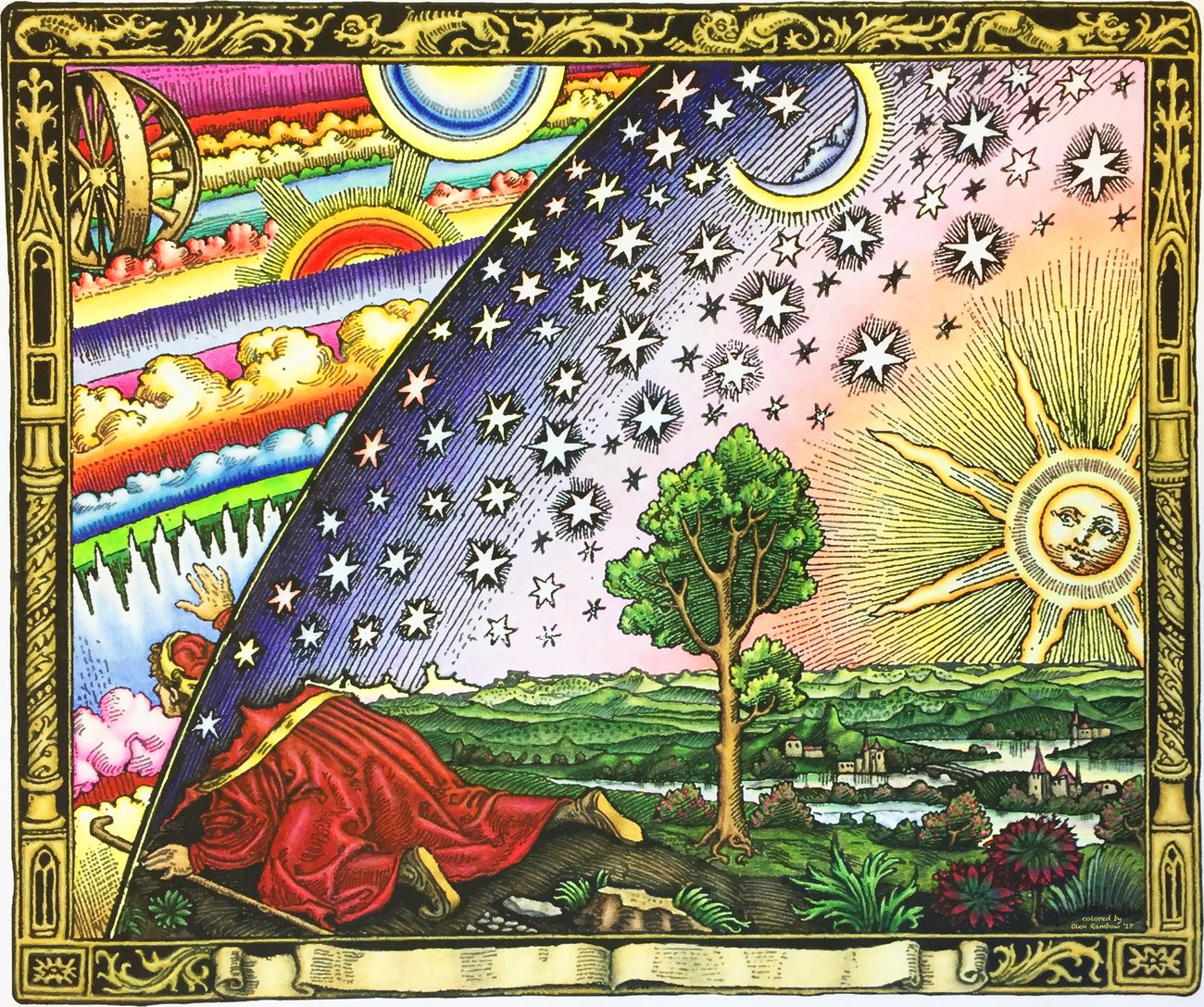
Anonymous engraving published by the astronomer Camille Flammarion in L’Atmosphère (1888). A traveler has walked to the edge of the world; he pushes his head through the vault of the stars to see what makes it turn. Tap the markers to follow the image.
Camille Flammarion, L’Atmosphère : météorologie populaire, 1888, p. 163 · colored in pencil by Houston Physicist, CC BY-SA 4.0, via Wikimedia Commons
The planets do not “cause” specific events any more than the hands on a clock “cause” a specific time.
Astrology is a tool for foresight far more than for prediction.
IIIThe sky as seen from here
The word planet comes from the Greek planêtês, “wanderer.” Seen from Earth, the stars turn together every night, as if fixed to a vault, but five points of light move slowly among them. And sometimes they seem to stop, go backward for weeks, and then set off again.
The ancients built very ingenious systems to describe these loops, with circles carried on other circles. In 1543, Copernicus supplied the key, which is that the Earth moves. When it overtakes a slower planet, the way one car passes another on the highway, that planet appears to drift backward against the background of the sky.
Astrology deliberately keeps this point of view, the one from the place where you were born. The diagram is computed from the real positions of the planets. Slide the viewpoint from the Sun to the Earth: the calm orbits turn into loops, and the line from the Earth to the planet stays the same in both views.
Everything that follows starts from this view from Earth. The signs divide the path the Sun seems to follow over a year. The houses divide the circle of the sky over a day. The aspects measure the angle between two bodies, as we see them from here.
IVA year divided into twelve
The zodiac is often pictured as a list of twelve personalities. Tradition builds it from a few simple principles, which thinkers of antiquity set out one by one. The diagram adds them as you read.
The year first. The signs are twelve portions of the Sun’s apparent path, starting from the spring equinox. Twelve, because a year holds a little over twelve lunar months, and the Babylonian calendar had twelve months of thirty days. The signs are no longer the constellations that gave them their names. Over two thousand years, the constellations have shifted by almost a whole sign, because the Earth’s axis turns slowly, like that of a wobbling top. So the zodiac is first of all a calendar, and its images are those of the seasons in the Northern Hemisphere, where it was born.
Two breaths. Ptolemy describes six signs as masculine and diurnal and six as feminine and nocturnal, alternating “because day is always yoked to night and close to it.” These words name two principles, and every chart contains both. One radiates outward, the other receives and holds. Today we might say active and receptive, or yang and yin.
Four elements. The philosopher Empedocles saw the world as made of four “roots” that Love mixes and Strife separates: fire, air, water and earth. Aristotle gave them qualities. Fire is hot and dry, air hot and wet, water cold and wet, earth cold and dry. Tradition assigns an element to each sign, and each element comes back three times around the circle, in a triangle.
Three moments in each season. Ptolemy also distinguishes, within each season, a sign that opens it, one that holds it and one that carries it over into the next. Aries opens spring, Taurus settles it, Gemini prepares the way for summer. Today these are called cardinal, fixed and mutable, and the same movement returns with every season.
Twelve signs. Four elements and three moments give twelve combinations, all different. Aries is fire beginning in spring; Leo, fire holding steady at the height of summer; Sagittarius, fire passed on at the end of fall. Each sign is also understood through its neighbors and through the sign that faces it, the way a color is understood through its complement.
Four elements and three moments: twelve signs, all different.
Tap or hover over a sign to see what it is made of.
VSeven planets and their homes
To the naked eye, seven wandering bodies are visible: the Sun, the Moon, Mercury, Venus, Mars, Jupiter and Saturn. The Greeks first gave them names that described them. Saturn was Phainôn, “the shining one”; Mars, Pyroeis, “the fiery one,” for its color; Mercury, Stilbôn, “the twinkling one.” Later they gave them the names of their gods, borrowed from the gods of Babylon, and it is these gods, under their Latin names, that we still use.
Ptolemy explains why each planet has its own signs, its “domiciles.” Cancer and Leo, the signs of summer and the hottest, go to the two luminaries, the Moon and the Sun. Then, moving outward on each side, the planets take their signs in order of distance. Mercury, the fastest, sits right next to them; Saturn, the slowest and coldest, at the far end, facing the luminaries. Step through the figure.
Saturn, the slowest (29 and a half years) and the coldest, takes the winter signs, facing the luminaries: Aquarius and Capricorn.
Each planet thus gets two faces, one on the Sun’s side and one on the Moon’s. The myths add their own. Saturn is Kronos, the god of the golden age, who was confused very early with chronos, time, and tradition gives him heaviness, along with depth and patience. Mercury is Hermes, the messenger, god of thresholds and crossings. Tradition sees in Venus what attracts and connects, in Mars what cuts and accomplishes, in Jupiter, king of the sky, what makes things grow. The Sun stands for what we seek to become, and the Moon for what we have received.
The three modern planets were discovered by telescope: Uranus in 1781, Neptune in 1846, Pluto in 1930. Their names were chosen by astronomers; it was an eleven-year-old English girl, Venetia Burney, who suggested “Pluto.” Astrologers then built their meanings, partly on their myths, partly on the history of the period in which they were found. These meanings are therefore much more recent than those of the seven ancient bodies.
No ancient system had room for them: seven planets, seven days of the week, and Ptolemy’s domiciles end with Saturn. Yet Galileo drew Neptune in 1612, without knowing it was a planet. In 1846, Le Verrier calculated its position from the irregularities in the motion of Uranus, and it was found within a degree of his prediction. You sometimes read that an astrologer described Neptune before its discovery; we have found no serious evidence of it.
VITwelve houses around the horizon
The signs follow the year; the houses follow the day. In twenty-four hours, the Earth’s rotation carries each body through four moments. It rises in the east, climbs to its highest point in the sky, sets in the west, then passes its lowest point, beneath our feet (for the Sun, around midnight). These four points are the angles of the chart: the Ascendant, the Midheaven, the Descendant and the Imum Coeli.
A house is a portion of the sky measured from these angles, and each one corresponds to an area of life. It tells where a planet acts. According to Vettius Valens, in the 2nd century, a planet sets in motion the affairs of the house it occupies. The same Venus tells a different story in the seventh house, the house of unions, and in the tenth, the house of career.
The Greeks called the houses “places,” and they drew their meaning from the course of the day. A body at its highest point is seen by everyone, so the house at the top speaks of reputation and public life. A body at its lowest is hidden, and the house at the bottom speaks of home, roots, what stays out of sight. The rising house belongs to the person, and Valens calls it the steering-oar.
Each angle opens a house. Next to it, one house is about to reach the angle as the sky turns, and another has just left it. That makes three houses per angle, and twelve in all, numbered from the Ascendant.
Another ancient idea colors several houses. Each planet has a house where it rejoices, and part of that house’s meaning comes from the planet. Venus rejoices in the fifth, called Good Fortune, which speaks of pleasures and children. The diagram shows the seven joys.
Over a day, the Earth’s rotation carries each body above the horizon, from east to west, then below it. Here, the Sun.
There are several ways to draw the houses. The oldest makes each sign a whole house, starting from the rising sign. Others divide the sky more finely; the system of Placidus, from the 17th century, is the most widely used today, and it is the one our readings use. You will often read that the 1st house corresponds to Aries, the 2nd to Taurus, and so on. That equivalence took hold in the 20th century, and we leave it aside.
Astrologers themselves don’t give every house the same weight. André Barbault, one of the great French astrologers of the 20th century, considered only the four angles solid; for the others, he wrote, “nothing is formally established as far as foundations go.”
VIIPlanets that look at each other
The word aspect comes from the Latin aspicere, to look at. For the Greek astrologers, two planets in aspect see each other and can therefore act on each other; those that don’t see each other are turned away. Ptolemy speaks of signs that “behold” each other, and of neighboring signs that are “as it were averted from one another.”
He keeps the angles that divide the circle into equal parts: the half (180°, the opposition), the third (120°, the trine), the quarter (90°, the square) and the sixth (60°, the sextile). Since twelve divides by two, three, four and six, each of these angles traces a regular figure on the circle of signs, a diameter, a triangle, a square or a hexagon. The conjunction is added to these, when two planets come together.
Each figure links signs that have something in common. The trine links three signs of the same element. The square links four signs of the same moment in the season, the ones that open, hold or carry over. The sextile links signs of the same polarity, whose elements get along, fire with air, earth with water. The opposition links two signs of the same polarity and the same moment, set face to face. Neighboring signs, and signs five apart, have nothing in common; they don’t see each other.
Ptolemy calls the trine and the sextile harmonious, because they are composed of signs of the same kind. The square links an active sign and a receptive one; the opposition sets two signs face to face. Both are tense. A square pushes you to act, an opposition makes you take the other side into account.
The ancients first counted aspects from sign to sign, then looked at the exact angle. Today they are measured only by degree, with a margin called the orb; the closer the angle is to exact, the stronger the link.
André Barbault also saw a cycle in them. Two planets set out together at the conjunction, draw apart until the opposition, then come back together, like the Moon and the Sun over a month. Each aspect is a moment in this cycle, and it takes its meaning from its place there.
VIIIReading a whole chart
A single placement says little. A Sun in Aries is lived differently depending on the Moon, the Ascendant or the planets that aspect it. So a reading starts with the whole: the element and the moment of the season that dominate, the strongest planet, and the planet that rules the sign of the Ascendant. It then looks for what repeats from one factor to another, and for what contradicts.
André Barbault compared the chart to an orchestra in which each planet plays its own instrument and the dominant planet acts as conductor; it is through that planet that you enter the reading. A chart often revolves around two, three or four centers that have to be held together.
Aspects are not the only links. A planet also depends on the one that rules the sign it occupies, and two planets refer to each other when each one sits in the other’s sign. The glossary explains these links one by one, and the sample readings show them at work. In a reading, clicking the chart takes you to the passage that explains the element you touched.
A written reading has a limit, which Liz Greene pointed out when discussing computer-generated interpretations. The chart doesn’t say what the person has made of what they were given, or what they have chosen. Barbault spoke of a “collaboration between interpreter and interpreted.” On this site, the reading makes proposals, and it is up to you to say what holds.
The whole first. Each planet is tinted by the element of its sign, with fire 41%, water 34%, earth 17%, air 7%. Fire and the cardinal signs dominate.
Albert Einstein’s chart (March 14, 1879, Ulm, Germany), one of the sample readings, picked at random.
The whole first. Each planet is tinted by the element of its sign, with fire 12%, water 63%, earth 17%, air 7%. Water and the fixed signs dominate.
Marie Curie’s chart (November 7, 1867, Warsaw, Poland), one of the sample readings, picked at random.
The whole first. Each planet is tinted by the element of its sign, with fire 24%, water 32%, earth 32%, air 12%. Earth and the fixed signs dominate.
Frida Kahlo’s chart (July 6, 1907, Coyoacán, Mexico), one of the sample readings, picked at random.
The whole first. Each planet is tinted by the element of its sign, with fire 39%, water 7%, earth 34%, air 20%. Fire and the fixed signs dominate.
David Bowie’s chart (January 8, 1947, Brixton, London), one of the sample readings, picked at random.
The whole first. Each planet is tinted by the element of its sign, with fire 27%, water 17%, earth 20%, air 37%. Air and the fixed signs dominate.
Barack Obama’s chart (August 4, 1961, Honolulu, Hawaii), one of the sample readings, picked at random.
IXGoing further
Astrology isn’t limited to the birth chart. It has several branches, each with its own question, from the relationship between two people to the choice of a moment to act.
Some look at collective history. Richard Tarnas compares historical eras with the cycles of the slow planets; his central example is the meeting of Uranus and Pluto in the 1960s.
Other uses are more unexpected. In 1948, Donald Bradley published a “planetary barometer” for Wall Street, which some traders still calculate; no serious test has ever confirmed it. Kepler, who had to publish a yearly calendar of forecasts, logged the weather in Graz day after day starting in 1593 to check the influence of the stars. Since 1963, Maria Thun’s calendar has told gardeners which days are root, leaf, flower or fruit days according to the Moon; in 2017, blind tasters found no difference between a wine tasted on a fruit day and the same wine tasted on a root day.
Astrology also shows up in public life. In India, wedding dates are still chosen from a calendar of auspicious days. In 1988, the public learned that Nancy Reagan had an astrologer vet the president’s schedule. In China, some job ads have excluded entire signs, even though a 2020 study shows that sign predicts neither personality nor success at work. In the United States, about three in ten adults consult astrology, tarot or a fortune teller at least once a year, often through an app.
Reading your chart can help you understand yourself, as long as you keep a sense of nuance. What you read there doesn’t sum you up, and words give only a sketch of what the sky tells. Dane Rudhyar said the chart is “the acorn of the oak you can become.” Liz Greene pointed out that a horoscope doesn’t spare you the work of thinking for yourself.
- NatalA person’s birth chart. This is the one this site reads.
- SynastryTwo charts compared, to read a relationship.
- HoraryThe chart of the moment a question is asked (William Lilly, 1647).
- ElectionalChoosing the moment to act. Baghdad was founded this way, in 762.
- MundaneThe cycles of the slow planets and collective history (André Barbault).
- PsychologicalThe chart as an inner portrait (Dane Rudhyar, Liz Greene).
- ArchetypalHistorical eras and planetary cycles (Richard Tarnas).
- AstrocartographyThe lines of the planets on the world map (Jim Lewis, 1970s).
- FinancialPlanetary cycles and stock prices (W. D. Gann, Donald Bradley).
- Weather and sowingWeather and gardening days by the Moon (Kepler, Maria Thun).
A few curiosities of the sky to finish. The loops from the chapter on the sky each have their own rhythm. Mercury goes backward about three times a year, for three weeks; Venus every nineteen months, for six weeks; Mars about every two years, for ten weeks. Jupiter and Saturn go backward every year, for four to five months. Tradition readily sees these as a time for looking back over what the planet represents.
Finally, an old idea links the sky to music. Plato imagines a Siren on each circle of the heavens, each singing one note, all of them together forming a single chord. Ptolemy finds in the circle the ratios of the octave, the fifth and the fourth, and Kepler was still looking for this music in the speeds of the planets. It was while looking for it that he found his third law, one of the foundations of modern astronomy. The image has its limits, because the opposition gives the octave, the most consonant interval, whereas Ptolemy counts it among the tense aspects.
Sources
- Ptolemy, Tetrabiblos I.2-3, 10-12, 17, trans. F. E. Robbins (Loeb, 1940)
- Ptolemy, Tetrabiblos I.13-16 (the aspects, signs that behold each other), trans. F. E. Robbins
- Vettius Valens, Anthologies IV.12 (the twelve places), trans. Mark Riley
- C. Brennan, the origins of Hellenistic astrology, The Astrology Podcast 61
- C. Brennan et al., the twelve houses, The Astrology Podcast 231
- C. Brennan and C. Moon, the aspects, The Astrology Podcast 323
- D. Rudhyar, “The Birth Chart as a Celestial Message” (1976)
- Robert Hand, interview with Garry Phillipson (2002)
- C. and S. Harvey, Principles of Astrology (1999), ch. 5
- A. Barbault, “Pour une réhabilitation de l’astrologie” (2008), “La pratique des maisons,” “Approche d’une synthèse du thème” (in French)
- Liz Greene, on computer interpretations (Astrodienst)
- The Enūma Anu Enlil
- The Babylonian zodiac and its dates
- Hellenistic astrology
- Māshā’allāh and the founding of Baghdad
- Thomas Aquinas, Summa Theologica I, q. 115, a. 4
- The Yavanajātaka, the Greek horoscope in India
- The texts of Hermes, from Ficino to Casaubon
- Nostradamus
- Financial astrology (Urania Trust)
- Kepler and the weather (University of Cambridge)
- Blind tasting by the biodynamic calendar (2017)
- Joan Quigley, the Reagans’ astrologer
- Lu et al., astrological stereotypes and discrimination in China (2020)
- Pew Research Center, astrology in the United States (2025)
- C. Kowal and S. Drake, “Galileo’s observations of Neptune,” Nature 287 (1980)
- The discovery of Neptune (Paris Observatory, in French)
- Alan Leo
- C. G. Jung, synchronicity (1951-1952) and the experiment on couples
- R. Tarnas, Cosmos and Psyche (2006), p. 77
- Luc Bigé, interview in L’ADN (in French)
- D. Rudhyar, The Astrology of Personality (1936)
- Apparent retrograde motion
- Empedocles (Stanford Encyclopedia of Philosophy)
- The Greek names of the planets
- Placidus de Titis and his house system
- The Thema Mundi
- Plato, Republic X, 617b
- Kepler, Harmonices Mundi (1619)
- Venetia Burney and the name Pluto
- The Flammarion engraving (1888), colored

The positions in the diagrams are calculated with Astronomy Engine. The details of the sources, and what is attested or interpreted, are gathered in our research notes.